How to Teach English to Kids at Home: A Step-by-Step Plan
By the Clipart Scout team6 min read
Short answer
Start with short, regular sessions at a fixed time. The British Council says short, frequent sessions are better than long ones, and that fifteen minutes is enough for very young children. Begin with words the child can see, such as colors, numbers and greetings. Then add songs, stories and games, the alphabet and sounds, reading together and a little writing. Praise effort, and do not correct every mistake.
Key points
- The British Council advises short, frequent sessions, and says fifteen minutes is enough for very young children.
- Cambridge English and the British Council both recommend songs, stories with pictures and games.
- Mistakes are normal. Do not correct every one. Say the sentence back correctly instead.
- Keep using your home language. Talking, reading and singing in it supports a child's language development.
- There is no magic age to start. Regular, good-quality contact with English matters most.
On this page
- What do the British Council and Cambridge English advise parents?
- What are the steps for teaching English at home?
- What does one week of English at home look like?
- Should you correct your child’s mistakes?
- Should you keep using your home language?
- Is there a best age to start?
- What if your own English is limited?
- What to do next
You want your child to learn English, and you may not be sure where to begin. The short answer is to start small: a short session at the same time each day, using words your child can see and touch.
This guide gives a plan in six steps, an example week, and what the British Council and Cambridge English say about mistakes, the home language and age. The plan itself is our suggestion. The advice that is named as coming from a body is theirs. Our printables are in English, and you can use them with the plan as practice pages.
What do the British Council and Cambridge English advise parents?
Both bodies advise short, regular sessions, songs, stories and games, and patience with mistakes. The British Council says, “It is better to have short, frequent sessions than long, infrequent ones.” It also says, “Fifteen minutes is enough for very young children.” Another British Council article says that English sessions may last from a few minutes up to about ten, once or twice a day.
On routine, the British Council advises you to try to do certain activities at the same time every day and to use the same phrases each time. It says repetition is essential, because children often need to hear words and phrases many times before they say them.
Cambridge English says, “Learning a language takes time, and every child develops at their own pace.” It also recommends songs with rhyming words, stories for new vocabulary, and games that give a child a low-pressure way to use English.
What are the steps for teaching English at home?
Here is a plan you can follow. It is our suggestion, built on the advice above.
- Pick a fixed time and place. Choose ten to fifteen minutes when your child is rested. Tell your child before it starts, for example, “In three minutes we are going to have our English time.” The British Council suggests this kind of warning.
- Start with words your child can see and use. Begin with greetings, colors, numbers and family. Our word lists have pictures and listen buttons: English greetings and classroom phrases, colors in English and numbers 1 to 100 in English.
- Use songs, stories and games. Both bodies recommend them. Songs with actions suit very young children, and picture books let you point and say the words. Our English games for kids guide has easy activities.
- Add the alphabet and sounds. Go slowly. See how to teach the English alphabet and English phonics for beginners.
- Read together. Look at the pictures, say the words and let your child tell you what they see.
- Write a little. Begin with the child’s own name and a few letters, then short words.
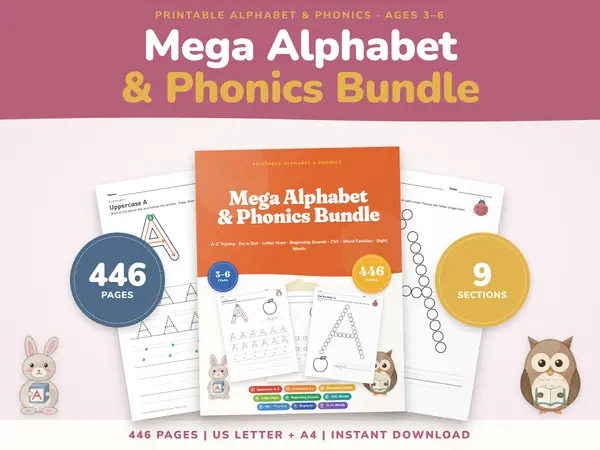
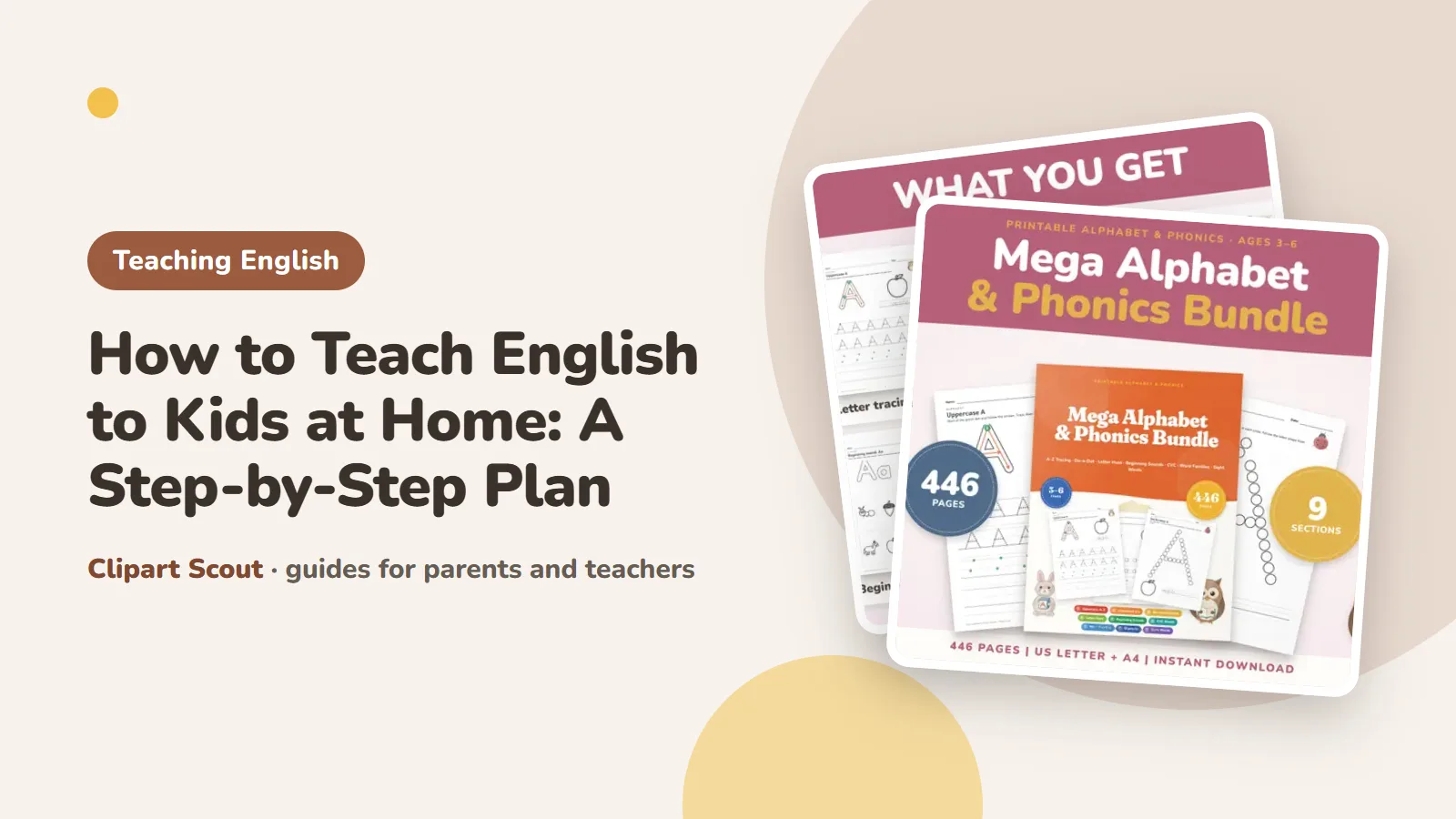
Our English alphabet page and the full vocabulary section give you the words for every step. The Alphabet Worksheets and Phonics Bundle has 446 pages in 9 sections, including uppercase and lowercase tracing, beginning sounds and CVC words, with answer keys.
What does one week of English at home look like?
This table is an example, not a rule. Change the activities to match your child and your day. Each session is 10 to 15 minutes.
| Day | Activity |
|---|---|
| Monday | Greet each other in English. Learn four colors with real objects |
| Tuesday | Sing a song with actions. Count objects from one to ten |
| Wednesday | Read a picture book. Point and say the words |
| Thursday | Play a color or animal game |
| Friday | Review the week’s words with cards |
| Saturday | Draw a picture and add one English word |
| Sunday | Rest, or sing a favorite song |
If your child is young, shorten the sessions. If your child is bored or restless, stop or change the activity. The British Council notes that children can usually only concentrate for short periods.
Should you correct your child’s mistakes?
Do not correct every mistake. The British Council says, “It’s natural to make mistakes when learning a language.” Cambridge English says making mistakes is a normal part of learning and helps children improve over time. Its parents’ booklet says that the important thing is for the child to say English words without worrying.
A simple method is to say the sentence back correctly. If your child says “I goed to the park,” you can answer, “Yes, you went to the park. Did you play?” Praise effort and communication. A British Council article also says there may be a silent period, when a child understands before speaking. During that time, do not force your child to repeat words.
Should you keep using your home language?
Yes. Talking, reading and singing in the home language supports a child’s language development. This is the position of US government and literacy organizations. A 2016 US White House fact sheet encourages parents to talk, read and sing with young dual language learners in their home language. Colorín Colorado says children who are read to in their first language have an easier time learning to read in a second language.
Nothing we read says that using the home language slows English. These sources are US guidance, mostly for families in the United States. A simple approach is to keep a short English time each day and use your home language the rest of the day. If your child needs a quick translation, a British Council article says you can give it once, quietly, and not repeat it.
Is there a best age to start?
There is no magic age. Eurydice, the European Commission’s education information network, calls “younger is better” a common belief. It reports research in which older children can do better than younger ones at first, and it says young children need much more good-quality exposure to English. The British Council says young children often adjust their accent easily.
So the safe summary is: younger children often pick up pronunciation easily, older children often learn faster at first, and regular, good-quality contact with the language matters most. Start when your family is ready.
What if your own English is limited?
You can still do this. The British Council article on speaking English at home says that parents may worry about their accent, and that young children can adjust their accent to the English around them. Here are some suggestions of our own:
- Use the listen buttons on our word lists so your child hears each word said clearly.
- Learn together. Say, “I do not know this word. Let us find it.”
- Use short phrases and repeat them each day.
- Choose picture books with simple words.
- Ask your child’s teacher for advice. Cambridge English notes that a teacher can tell you the best ways to support learning at home.
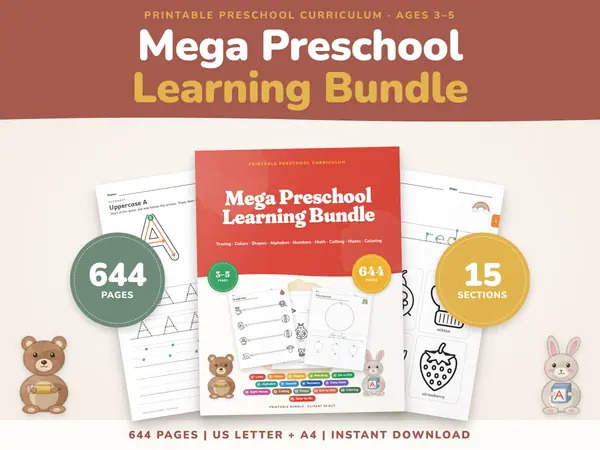
The Preschool Worksheets Bundle has 644 pages, with sections on colors, numbers 0 to 20 and the alphabet A to Z. It suits children aged 3 to 5.
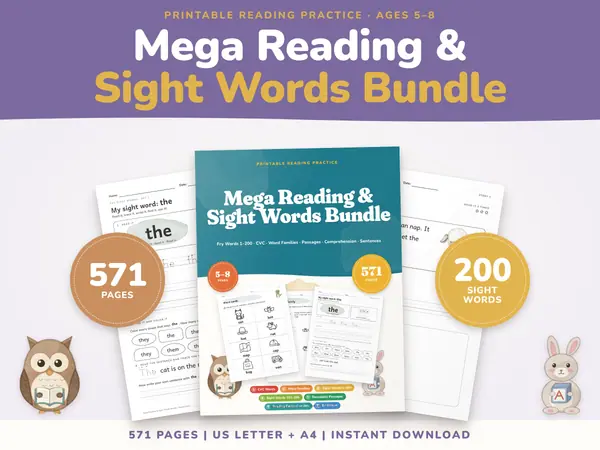
When your child is ready to read and write simple words, the Sight Words and Reading Bundle has 571 pages, with CVC words, word families and sentences.
What to do next
Print this checklist and tick each line.
Then try the first week in the table. After two weeks, look at what your child enjoys and change the plan. If you want printable practice pages, see our reading and phonics worksheets.
Sources
- How to start teaching kids English at home, British Council, LearnEnglish Kids.
- How children learn, British Council, LearnEnglish Kids.
- Speaking English at home, British Council, LearnEnglish Kids.
- How to help your child learn English, Cambridge English.
- How to practise English at home, Cambridge English.
- Focus On: Is younger always better for learning a foreign language?, Eurydice, European Commission.
- Why Reading to Your Kids in Your Home Language Will Help Them Become Better Readers, Colorín Colorado (WETA).
This guide is general information for parents and teachers. It is not medical, legal or professional advice. Every guide lists its sources at the end. More about our guides is on the About page.